The 15 Levels Of AI Coming For Your World
Almost everyone using AI is camped at Level 1 to 3: type a question into ChatGPT or Claude, get an answer, copy it, paste it, test it, ask for changes, repeat. If that's you, you're using about a fifteenth of the machine.
There are at least 14 levels above that, and each rung multiplies your leverage 5-10× over the one below it. Hardly anyone knows Levels 4 to 10 exist. And from Level 11 up, AI systems are already designing and improving drugs, materials, customer service, and themselves.
The limit you hit as you climb is rarely the AI. It's the size of the work you've been trained your whole life to ask for. Until about two years ago, one person could only take on the work of one person, so "ask the machine for the whole project, not the next task" is a skill almost nobody has had a reason to practice. The leverage on this ladder only shows up if you change the shape of what you ask for.
This page is the map. It shows where a solo or small team can actually camp (Levels 3 through 5), where the climb turns steep (6 through 10), and what's already running above you in pharma labs, materials science, and at Google DeepMind (11 through 15).
It ends with the one calibration line that lets you read all of this without sliding into either AI doom or AI hype.
Why nowFive Things Changed In 18 Months — And Suddenly The Whole Ladder Exists
Levels 3 and up are new. The shape of the work changed from "ask AI for an answer" to "give AI a work environment, memory, tools, and success criteria" — because five things shifted at once:
Raw reasoning
Frontier models (GPT-5.5, Claude Opus 4.7, Gemini 3.5) plan and execute, not just answer questions.
Long context
1M-token windows hold entire codebases, brand libraries, or research bases at once — AI keeps continuity instead of starting over each turn.
Tool and computer use
AI operates browsers, software UIs, file systems, and APIs. It can handle admin panels, click buttons, fill forms.
Media generation
Video, voice, image, and audio are now production assets you direct, not novelties you sample.
Managed agents
OpenAI, Claude, & Gemini Enterprise — agents are deployable now, and often spin into existence without you having to ask.
Where you can actually thriveLevels 1 Through 5: The Only Part Of The Ladder You Actually Need To Climb
For a solo or small team, Levels 3 through 5 are the sweet spot — one person plus AI replaces what used to need a 5-person agency. Beyond 5, the climb gets steep fast. The smart play is to get to 5, set up your systems, and then get off the ladder and enjoy the view.
You type a question. AI answers. You handle everything else — testing, fixing, copying, deploying. The default starting point for almost everyone.
AI creates, writes, edits and moves files directly on your PC and in the cloud. You decide what it's all for and how it works; the AI connects the dots. It sounds minor — it's the change that makes Levels 3 through 5 possible.
AI understands your whole project — multiple files, graphics, dependencies, data, the relationships between everything. It builds whole things, not snippets. This is where real leverage begins, and it's where you should aim first.
AI syncs and works with web pages and any other file type across your server or cloud storage. Not just code — files, knowledge bases, brand assets, datasets, configs. You stay focused on the next thing instead of manually shuttling files around. (Easy from a real harness like Claude Code in VS Code; harder from a chat-app environment without a sync hook.)
Scheduled, unprompted work on your sites. Agents auto-research current events, rewrite pages so they stay legible to both Google and AI agents, detect content decay, refresh creative. This is the first level that runs without you in the room — it frees you instead of just scaling you. For solo operators, this is the right place to stop and live.
L4 To L5: The Moment AI Stops Waiting For You To Ask
At Level 4, you still drive every change — the AI executes and deploys, but you initiate. That's powerful, but it only scales you; it doesn't free you. At Level 5, your systems run on their own clock. The AI fetches news, checks rankings, rewrites stale pages, generates next month's ad variants, and reports back. You stopped being the bottleneck.
This is the single biggest compounding moment in solo AI work. Below Level 5, you can run more things in parallel, but you're still doing the breakdown yourself, standing in the middle as the person who knows what all the pieces are. At Level 5, you stop describing tasks and start describing outcomes; a system you built describes the work to the systems that do the work. Your judgment, and refining those systems, is the only limit — and judgment scales much better than typing.
Stretch climbLevels 6 Through 10: Climb If You Want — But Read The Price Tag First
These are real and achievable, but they ask for more skill, more capital, and more operator burnout than most solo or two-person teams want to take on. If you camp at Level 5 and your business/life is thriving, there is no shame in not climbing further.
Multi-property orchestration. AI decides which of your sites or products gets attention this week based on traffic and conversion data. Cross-property memory and prioritization built in — so it stops thinking each site is its own universe.
Closes the entire build-to-sell loop. Runs ads, writes email sequences, A/B tests offers, optimizes funnels. Stripe + ad platforms + email APIs all wired into one agent supervision layer. The marketer-engineer hybrid judgment is the constraint, not the build time.
Two parts, very different difficulty. Part A: spots gaps in search trends, competitor weakness, and social signals — this is easy and cheap with Deep Research agents. Part B: an automated product builder that takes those signals and ships actual products without human intervention. Part B is 95% of the cost and effort.
AI handles support, refunds, partner ops, and vendor relationships within guardrails. The non-glamorous CEO job. Multi-agent stack plus a policy and compliance layer. The hard part is not build time — it's edge cases, which reveal themselves only with real customer volume.
AI audits its own performance and improves its own prompts, model choices, and agent designs. Fields where this is already happening at small-team scale:
- Prompt-optimization frameworks like DSPy and TextGrad — AI agents rewrite their own prompts based on automatic output evaluations.
- AutoML pipelines — AI picks model architectures and tunes hyperparameters without a human in the loop.
- Self-correcting code agents — the agent reviews its own output, finds errors, re-iterates until it passes.
- Agent-scaffolding evolution — agents adjusting their own context, memory, and tool choices on the fly based on task feedback.
L10 is the small-team-feasible version of what Level 15 does at frontier-lab scale. Worth knowing it exists, even if you never build one.
Not sci-fi — already happeningLevels 11 Through 15: AI Is Already Designing Drugs, Running Cities, And Improving Itself
These exist right now, in 2026, and they get almost no coverage outside trade journals. This section isn't here to make you climb — you won't — it's here so you know what's already real. Every example below is verified, with named programs and citations.
AI generates hypotheses, designs molecules or materials, plans experiments, and controls robotic labs to execute them — a closed discovery loop, with humans reviewing and greenlighting at clinical milestones.
Insilico Medicine — INS018_055 (rentosertib), a TNIK inhibitor for idiopathic pulmonary fibrosis. The first drug with both target and molecule fully designed by AI, currently in Phase 2 clinical trials (ClinicalTrials.gov NCT05938920).
Isomorphic Labs (DeepMind spinoff) — nearly $3 billion in pharmaceutical partnerships with Eli Lilly and Novartis to deploy its AlphaFold-based IsoDDE drug design engine against historically undruggable disease targets. First trials expected late 2026.
Recursion Pharmaceuticals — REC-4539, an AI-designed LSD1 inhibitor for small-cell lung cancer, now in Phase 1 clinical trials. Industrial-scale platform processing petabytes of automated wet-lab biology data.
Lawrence Berkeley National Laboratory A-Lab — autonomous materials synthesis. 41 novel compounds in 17 days (Nature, late 2023), and as of 2026 has demonstrated autonomous "pivots" in research strategy based on unexpected findings.
Carnegie Mellon Coscientist, Glasgow Chemputer / Chemify, and University of Liverpool mobile robotic chemists (Google "Hive Mind" funded, late 2026) are running autonomous chemistry experiments end-to-end.
Sakana AI Scientist — end-to-end autonomous machine-learning research. One generated paper accepted at a top-tier ML conference workshop.
AI provides planetary-scale foresight. Governments and NGOs use that foresight to reallocate human and financial resources to high-value public good outcomes.
Google Flood Hub — operating in 80+ countries, hundreds of millions of people protected, seven-day forecasts triggering pre-positioned humanitarian response. Credited with thousands of lives saved annually.
Singapore SkillsFuture and EU national employment platforms — AI-guided workforce reallocation. Analyzes labor market data, predicts skill needs years out, steers government training funding toward green economy and healthcare.
AI does original science via robotic and cloud labs. Designs experiments, runs them, analyzes data, writes papers.
LBNL A-Lab — closed-loop autonomous materials synthesis (see L11 entry).
AI Scientist ecosystem — AI agents (Coscientist and similar) plus commercial robotic cloud labs (Emerald Cloud Lab, Strateos) now run thousands of experiments daily for pharma and biotech clients. By 2026, specialized agents collaborate: one for literature review, one for experimental design, one for data analysis, all orchestrated inside a cloud lab.
Sakana AI Scientist — autonomous ML research paper generation, peer-review-accepted at workshop level.
AI manages infrastructure at city or regional scale: traffic, emergency response, public services, water, grid, supply chains.
Hangzhou City Brain 3.0 (Alibaba) — serves 13 million people, autonomous traffic-signal control across thousands of intersections, computer-vision incident detection, 15-20% cut in emergency-vehicle response times. 2026 evolution deepens into social governance, public services, environmental monitoring.
Miovision TrafficLink (formerly Pittsburgh Surtrac, CMU spin-out) — decentralized AI traffic-light agents at hundreds of intersections in dozens of North American cities. Documented up to 25% travel time reduction, 40% idle time reduction, ~20% emissions reduction in deployed corridors. Now integrating with connected and autonomous vehicles.
AI designs better AI: better algorithms, better training methods, better agent systems. The recursive loop most public AI discussion treats as science fiction is, in 2026, a genuine and bounded reality inside frontier research labs.
DeepMind AlphaEvolve — Gemini-powered evolutionary coding agent. On 50+ open math and CS problems, rediscovered state-of-the-art solutions in 75% of cases and discovered novel improvements in 20% of cases. Improved the best-known bound on the "kissing number" problem. Optimized Google's own TPU circuit design and improved data-center cooling scheduling — AI making its own hardware faster.
Anthropic Automated Alignment Researchers — Claude-powered agents conducting AI safety experiments autonomously. Includes "weak-to-strong supervision" (small models supervising larger ones) and "Natural Language Autoencoders" that translate one Claude's internal neural activations into human-readable text — one model reading another model's thoughts.
OpenAI o-series training methodology — reinforcement learning where AI-based verifiers grade intermediate reasoning steps during training. State-of-the-art on AIME math, Codeforces coding, GPQA scientific reasoning.
Sakana Evolutionary Model Merging — evolutionary algorithm "breeds" capable models from existing open-source ones without massive new training runs.
Industry-wide standard practice by 2026: using highly capable models to generate synthetic training data for newer models (Meta's Llama 3 family used this), and using AI agents to red-team and audit other AI models at scale (Google AI Red Team, Microsoft).
The honest readThe One Line That Keeps You Sane About All 15 Levels
After three deep-research scans verifying every named program above, this is the single line that sums up where AI actually is in 2026 — the line most public commentary won't give you because committing to it loses you the doom audience and the hype audience simultaneously:
"We have automated many steps of the ladder, but humans are still choosing which wall to lean it against."
This is what the doom narrative misses. Recursive self-improvement is real, but bounded. Humans set the goals, design the overarching systems, interpret results, make the strategic decisions. AlphaEvolve doesn't decide what to optimize — DeepMind researchers do. The o1 verifier doesn't decide what counts as "good reasoning" — OpenAI engineers do.
This is also what the hype narrative misses. AI is not a "thing you ask for output." It is, increasingly, production infrastructure — running pharma discovery pipelines, controlling 13-million-person city traffic systems, generating training data for the next generation of itself. Treating it as a glorified search engine is starting to look as quaint as treating the internet as a digital newspaper.
AI in 2026 is real production infrastructure, operated by humans who still own the direction. Direction-setting is judgment work, and your decades of knowing what's worth building count for more here than any technical skill. Pick your level, camp there, and choose the wall your own ladder leans against.
Where to start the climbThree Books That Walk You From Level 1 To Level 5
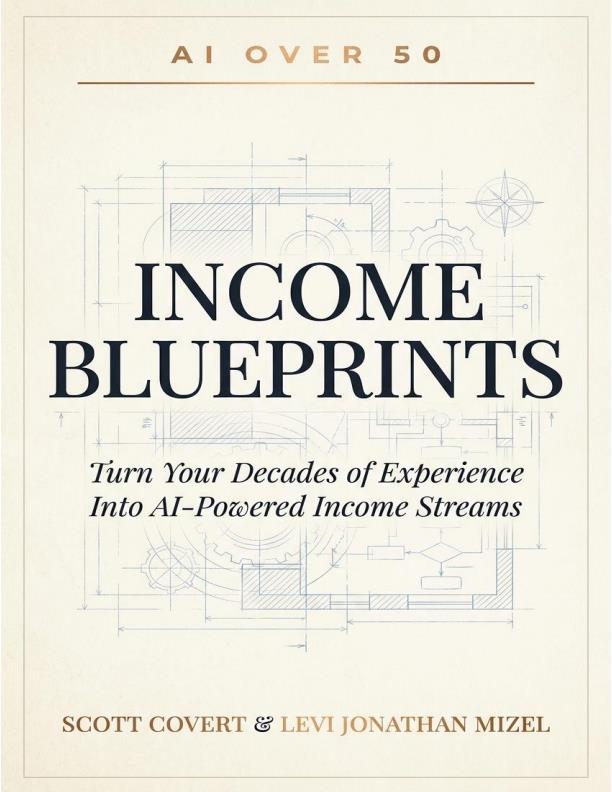
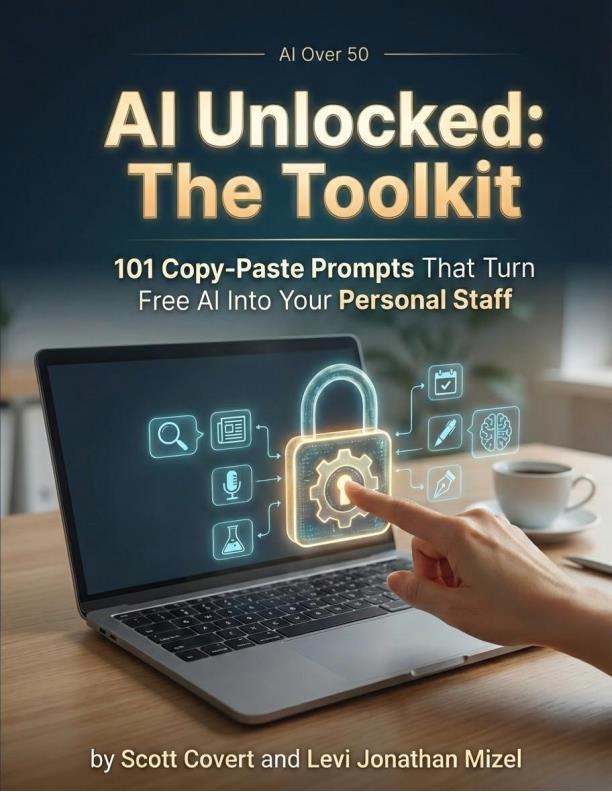
Climbing from Level 1 to Levels 3-5 is what these three books cover — written for the over-50 reader, in order of how to actually use them. Start with the main book. Add Income Blueprints when you're ready to monetize what you already know. Add the Prompt Toolkit when you want the exact wording in 10 seconds.