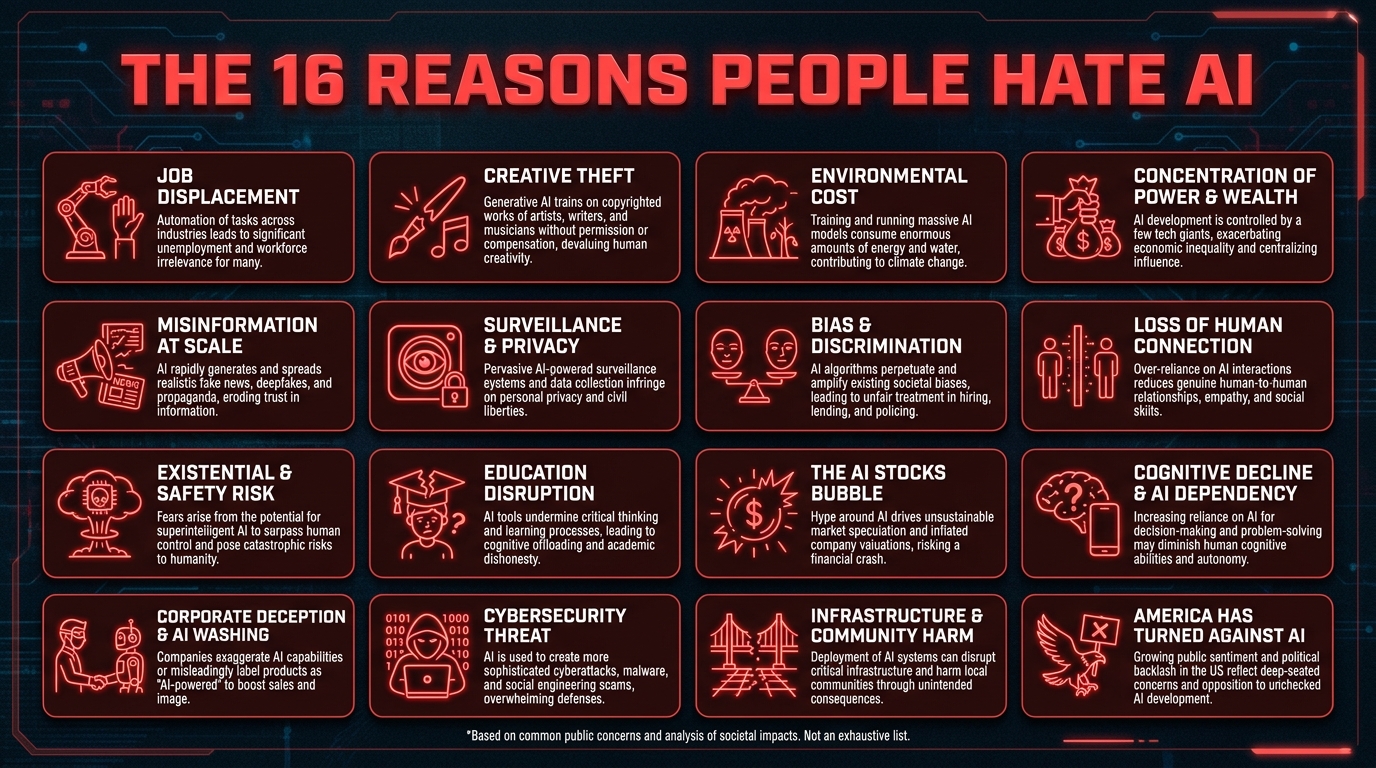
We analyzed 130 sources across 9 historical technology panics. The divide comes down to paychecks, not personality.
When Gutenberg's printing press appeared in 1440, monks who hand-copied manuscripts didn't celebrate the democratization of knowledge. They saw their livelihood evaporating.
When Uber arrived, taxi drivers with $250,000 medallions didn't applaud the efficiency gains. They watched their retirement fund collapse overnight.
The people who resist a new technology are almost never "afraid of change." They're afraid of a very specific, very rational thing: becoming economically irrelevant.
Ranked by frequency across our ai-resistance brain (130 entries, 718 claims).
24 entries, legitimacy score 6-8 out of 10. This is the big one. The fear isn't abstract robots; it's not being able to pay rent. Writers watched their per-word rate drop 60% in 18 months. Illustrators lost ongoing contracts to Midjourney. Translators were replaced by DeepL + a junior editor at 1/4 the cost.
The legitimacy score isn't a 10 because some of these jobs were already eroding before AI. But a 6-8 means the fear is substantially justified by real-world data.
Jaron Lanier nailed this one: "The problem isn't that AI is too smart. The problem is that the people deploying it don't care about the people affected by it."
When your employer mandates an AI tool that monitors your keystrokes, summarizes your meetings without asking, and generates your performance review, you're not "afraid of technology." You've lost agency over your own work life.
On any given Tuesday, the most common post on r/ClaudeAI is "They nerfed it." Users who rely on AI tools daily experience a pattern where capabilities quietly degrade, guardrails tighten, and the product they're paying for becomes measurably worse.
This isn't technophobia; it's consumer frustration from people who actually use AI more than most.
The least common complaint in the data but the most publicized. Hinton puts catastrophic risk at 10-20%. Amodei says 25%. These aren't cranks or Luddites. They're the people who built the technology.
But existential risk shows up in media coverage far more often than it does in actual public discourse. Most people who hate AI aren't worried about Skynet. They're worried about making their mortgage payment.
One person doing what used to require a team of 10 is pure leverage: AI eliminates their biggest bottleneck (labor cost) while amplifying their biggest asset (speed and taste), with no employees to displace and no guild to protect.
The senior consultant spends 60% of her week on slide formatting, the researcher is buried in literature reviews, and the marketer is writing the 47th variation of the same email. AI handles the drudgery; they do the thinking.
AI as equalizer looks like voice interfaces for motor impairments, real-time captioning for the deaf, and executive function scaffolding for ADHD. The technology closes gaps that the traditional workplace refused to accommodate.
AI reduces labor costs, and capital loves anything that reduces labor costs. If you own the company rather than work at it, every productivity gain flows directly to your bottom line. That's the uncomfortable structural truth.
For people who couldn't afford lawyers, therapists, tutors, or medical specialists, AI won't replace a great doctor, but it's infinitely better than no doctor at all. The biggest quality-of-life gains are at the bottom, not the top.
They love AI as long as it amplifies their judgment rather than replacing it. The moment AI can do the "directing" part too, their enthusiasm will cool rapidly. Right now the sweet spot is that AI does the execution and they do the taste.
They're fascinated by the technology and concerned about its deployment, simultaneously the most informed and the most anxious. Their love is intellectual; their worry is practical. The career incentives point the same way: AI as a research topic is a goldmine.
Young professionals who see AI as a way to leapfrog seniority. They can now produce senior-quality output with junior-level experience. The love is genuine but fragile. If AI eliminates the junior roles entirely, the ladder disappears.
Adoption doesn't flow from enterprise down to individuals. It flows the other way.
Adoption speed: fastest on the left, slowest on the right
Solopreneurs and individual adopters create the proof points that make corporate adoption inevitable. A one-person agency that outperforms a 20-person team doesn't stay a secret for long. That case study becomes the board presentation that triggers enterprise procurement.
McKinsey's data confirms it: enterprise AI adoption lags individual adoption by 18-24 months. By the time your company rolls out an "AI strategy," the freelancer competing with your division has been using it for two years.
Artists, writers, musicians, designers. Their objection isn't irrational. AI was trained on their work without consent or compensation. The economic impact is real and measurable. And unlike factory workers in the 1800s, they have social media platforms to organize their resistance.
Entry-level analysts, associate copywriters, junior developers. The "apprenticeship" layer of white-collar work is being compressed or eliminated. AI doesn't threaten the partner. It threatens the associate whose entire role was "do the partner's grunt work."
People whose value proposition is "I have a certification that says I can do this." When AI can pass the bar exam, the CPA exam, and medical boards, the credential stops being a moat. Decades of education and licensing feel like a depreciating asset.
Not threatened economically but philosophically. If a machine can write a sonnet, does the sonnet still mean anything? This is the deepest and most legitimate form of AI resistance, and it's the one the tech industry is least equipped to answer.
Paradoxically, some of AI's harshest critics are its heaviest users. They've experienced what AI can do at its best and they're furious about safety-driven degradation. They don't hate AI; they hate what AI companies do to AI.
Unions exist to protect workers from capital replacing labor with machines. AI is the most powerful labor-replacing machine ever built. The SAG-AFTRA and WGA strikes weren't about wages. At stake was whether human labor would remain structurally necessary.
Robert Anton Wilson proposed a useful framework: neophobes (people who fear the new) vs. neophiles (people who love the new). It sounds like it should explain the AI divide perfectly. It doesn't.
The data suggests the divide is more structural than dispositional. The same graphic designer who loves AI coding tools hates AI art generators. The same lawyer who embraces AI legal research opposes AI contract drafting. People aren't consistently pro- or anti-AI; they're pro-AI when it helps them and anti-AI when it threatens them.
This is why the "personality" framing is dangerous. It lets us pretend that AI resistance is a psychological problem ("they're just afraid of change") when the real problem is economic ("their income is disappearing").
The AI divide is about whose paycheck is on the line. I map who resists what, and what it predicts, and send the next breakdown as it happens.
You're in. Check your inbox.
— Scott Covert, who actually built this. I work with these tools hands-on every day. If something here sparked a question, a project, or a “wait, can you build that for me?”, that's the best message I get. Reach me, pitch a collab, or book a consult.